

Best AI Tools for Digital Marketing: From Content Creation to Lead Generation
Best AI Tools for Digital Marketing: From Content Creation to Lead Generation
Best Digital Web
September 25, 2026
Blog
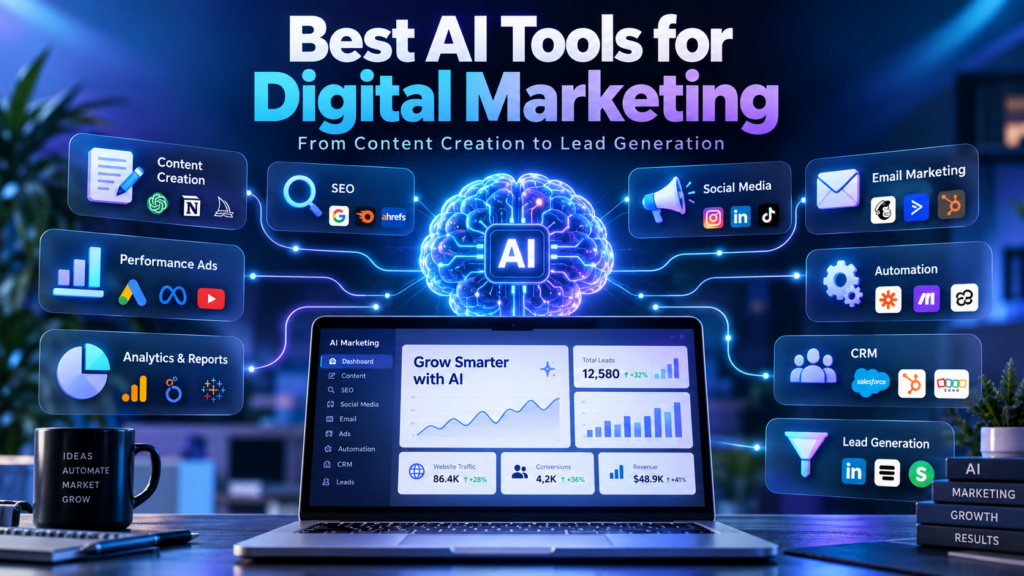
Best AI Tools for Digital Marketing: From Content Creation to Lead Generation
Digital marketing has always been about understanding people, finding the right audience, creating the right message, and delivering it at the right time. What has changed is the speed at which marketers can now do all of this.
That change is being driven by AI in digital marketing.
Artificial intelligence is no longer limited to generating captions or writing blog posts. Today, marketers use AI to research audiences, discover keywords, create content, design creatives, analyze campaigns, automate repetitive work, personalize customer journeys, optimize advertising, and even identify promising leads.
For businesses, agencies, and marketing professionals, this creates a major opportunity. The goal is not to replace marketing teams with AI. It is to use AI to remove repetitive work so marketers have more time for strategy, creativity, customer understanding, and decision-making.
In this guide, we explore some of the best AI tools for digital marketing, from content creation and SEO to performance marketing, social media, automation, analytics, and lead generation.
What Is AI in Digital Marketing?
AI in digital marketing refers to the use of artificial intelligence technologies to improve how businesses plan, create, execute, analyze, and optimize their marketing activities.
Traditional digital marketing often involves large amounts of manual work. A marketer may spend hours researching keywords, studying competitors, creating variations of ad copy, preparing reports, analyzing campaign data, and following up with leads.
AI can speed up many of these tasks.
For example, marketers can use AI to:
Generate content ideas
Research customer questions
Create first drafts of blogs and advertisements
Analyze keywords
Generate images and marketing creatives
Personalize emails
Automate workflows
Summarize campaign performance
Identify patterns in customer data
Optimize advertisements
Prioritize leads
Create reports
The biggest advantage of digital marketing with AI is therefore not simply producing more content. It is making the entire marketing workflow more efficient.
Why AI Is Becoming Important in Digital Marketing
Marketing teams work across multiple channels today.
A business may simultaneously manage Google Search, Instagram, Facebook, YouTube, email marketing, SEO, WhatsApp enquiries, website leads, CRM systems, landing pages, and paid advertising.
Managing these channels manually can become difficult, particularly as campaigns grow.
This is where AI and digital marketing work well together.
AI can process information much faster than a person, while humans remain responsible for understanding brand positioning, customer emotions, business objectives, creative direction, and final decisions.
An effective modern marketing workflow therefore looks more like:
Human Strategy → AI Assistance → Human Review → Campaign Execution → Data Analysis → Optimization
Rather than:
AI → Publish Everything Automatically
The difference is important.
The businesses that benefit most from AI are usually not those generating the highest volume of AI content. They are the ones using AI intelligently within a structured marketing system.
Best AI Tools for Digital Marketing
There are hundreds of AI tools available today, but marketers do not need all of them.
The better approach is to select tools based on the actual marketing problem you are trying to solve.
Here are some of the most useful categories.
1. ChatGPT – Content, Research and Marketing Strategy
ChatGPT has become one of the most flexible tools for AI digital marketing workflows.
Marketers can use it for far more than writing articles.
How Digital Marketers Can Use ChatGPT
You can use ChatGPT for:
Content brainstorming
Blog structures
Customer persona development
Competitor research frameworks
Social media ideas
Ad copy variations
Landing-page copy
Email sequences
Video scripts
SEO content planning
Marketing reports
Campaign analysis
Sales communication
FAQ generation
A marketing agency, for example, can provide campaign information and ask ChatGPT to organize performance observations into a client-friendly report.
A content team can take one long-form article and develop ideas for Instagram posts, LinkedIn content, email newsletters, reels, and short-form videos.
The quality of the result, however, depends heavily on the context you provide.
Instead of asking:
“Write Instagram content for my company.”
A better prompt would include your audience, service, customer problem, location, tone, objective, previous campaign performance, and desired call to action.
AI becomes much more useful when it understands the business context.
2. Gemini – Research and Content Assistance
Google Gemini can be useful for research, ideation, content planning, document analysis, and productivity.
Digital marketers can use Gemini when they need help organizing information, exploring campaign ideas, understanding a subject, or developing different approaches to content.
It can be particularly valuable when marketing teams already work heavily within the Google ecosystem.
Possible uses include:
Researching topics
Brainstorming campaigns
Summarizing information
Developing content ideas
Creating initial copy
Analyzing documents
Planning presentations
Instead of depending entirely on one AI platform, marketing teams can test different tools and choose the one that works best for each task.
3. Canva – AI-Powered Marketing Design
Great marketing requires more than good copy.
People often see the creative before they read the message.
Canva has made visual content creation easier for businesses that do not have a large professional design team.
Its AI-assisted capabilities can help marketers develop and adapt creative assets for social media, advertisements, presentations, and other campaigns.
Marketers Can Use Canva For:
Instagram creatives
Facebook ads
Presentations
Carousels
YouTube thumbnails
Short videos
Marketing banners
Infographics
Promotional materials
Creative resizing
AI can accelerate the production process, but brands should still maintain consistent fonts, colors, layouts, image styles, and creative guidelines.
The objective should not be to generate random designs quickly.
It should be to produce high-quality content faster while maintaining a recognizable brand identity.
4. Semrush – AI, SEO and Competitor Research
SEO remains one of the most valuable long-term digital marketing channels.
Platforms such as Semrush combine keyword research, competitor analysis, SEO insights, content workflows, and increasingly AI-focused search visibility features.
Marketers can use Semrush for:
Keyword research
Competitor keyword analysis
Backlink research
Website audits
Content gap analysis
Rank tracking
Content optimization
Search visibility monitoring
For marketers working on AI in digital marketing, tools like Semrush are useful because AI-generated content still requires proper SEO research.
AI can help create content.
SEO data helps determine what content is worth creating.
That distinction matters.
5. Ahrefs – SEO Research and Content Opportunities
Ahrefs is another widely used digital marketing platform, particularly for SEO.
It can help marketing teams understand what people search for, which pages attract organic traffic, where competitors earn backlinks, and where new content opportunities may exist.
Common Marketing Uses
Keyword research
Competitor analysis
Backlink analysis
Content research
Website audits
Ranking analysis
A good SEO strategy should combine data with genuine expertise.
Instead of creating 100 AI-generated articles around random keywords, identify topics that are genuinely relevant to the business and provide a better answer than what is already available.
That creates sustainable organic growth.
6. Surfer SEO – AI-Assisted Content Optimization
Surfer SEO is designed to help content marketers understand how their pages compare with content already ranking for a particular search query.
It can assist with content structure, related terminology, optimization recommendations, and content planning.
It is particularly helpful after the first draft has been created.
However, optimization scores should not dictate every sentence.
If content becomes unnatural because a writer is forcing keywords into every paragraph, the page may become less useful for the actual reader.
Use SEO tools as guidance rather than treating every recommendation as a mandatory rule.
7. Grammarly – Editing and Content Quality
AI-generated copy often requires editing.
That is where Grammarly can be valuable.
Marketing teams can use it to review:
Grammar
Sentence clarity
Tone
Readability
Spelling
Professional communication
This is useful for blogs, emails, proposals, social posts, website content, and client communication.
Even when content is generated with AI, human editing should remain part of the process.
The final version needs to sound like the brand rather than a generic chatbot.
8. Adobe Firefly – AI for Creative Production
Adobe Firefly provides generative AI capabilities for visual workflows.
For digital marketers and creative teams, this can help with concept development, image generation, creative experimentation, and design workflows.
Potential applications include:
Campaign concept visuals
Background generation
Social media graphics
Promotional imagery
Advertising concepts
Creative variations
Visual AI can significantly reduce the time required to explore ideas.
However, brand teams should carefully review every generated asset before using it publicly.
9. HubSpot – AI for CRM, Marketing and Lead Management
Generating traffic is only one part of digital marketing.
The next challenge is converting visitors into leads and leads into customers.
HubSpot combines CRM, marketing, sales, customer communication, automation, and AI-supported capabilities.
Marketing teams can use it to manage:
Leads
Customer information
Email campaigns
Marketing automation
Sales pipelines
Lead nurturing
Website forms
Customer communication
This is where AI becomes especially powerful.
Instead of using AI only for content creation, businesses can use it closer to revenue-generating activities.
A lead entering through a website form can be captured, categorized, assigned, nurtured, and followed throughout the sales journey.
That connects marketing activity with actual business outcomes.
10. Zapier – Marketing Automation
One of the most valuable applications of AI is eliminating repetitive marketing tasks.
Zapier helps different applications communicate with one another and allows businesses to automate workflows.
Consider this example:
Website Form → CRM → Email Notification → Sales Assignment → Follow-Up Workflow
Without automation, someone may need to manually copy information between systems.
With the right workflow, much of that process can happen automatically.
Marketing teams can automate tasks such as:
Transferring leads
Updating CRM information
Sending notifications
Creating tasks
Organizing customer data
Triggering email sequences
Connecting marketing applications
This is one reason modern ai digital marketing is increasingly about workflows rather than individual tools.
11. Google Ads AI – AI Performance Marketing
Paid advertising is another area where AI has become deeply integrated.
Google Ads uses machine learning and automation across areas such as bidding, targeting signals, creative combinations, and campaign optimization.
For marketers focused on AI performance marketing, these capabilities can help manage campaigns at a scale that would be difficult to handle manually.
However, automation does not eliminate the need for marketers.
Human marketers still need to determine:
Campaign objectives
Conversion tracking
Landing-page strategy
Offer positioning
Audience strategy
Budget
Creative direction
Lead quality
Profitability
AI can optimize toward the information it receives.
If conversion tracking is incorrect, even advanced automation can optimize toward the wrong objective.
Therefore, strong tracking remains one of the foundations of successful performance marketing.
12. Meta Advantage+ – AI for Social Advertising
Meta has also integrated AI extensively into its advertising ecosystem.
Automated systems can assist with areas such as audience delivery, placement, creative selection, and campaign optimization.
This allows advertisers to test more combinations than they could reasonably manage manually.
But good advertising still starts with the fundamentals:
Strong Offer + Strong Creative + Clear Message + Correct Tracking + Relevant Landing Page
AI can amplify a good system.
It cannot permanently rescue a weak offer.
That principle applies across almost every area of digital marketing with AI.
13. Google Analytics 4 – Data and Marketing Insights
Marketing decisions should not be based purely on assumptions.
Google Analytics 4 helps businesses understand how users interact with websites and digital experiences.
Marketers can analyze areas such as:
Traffic sources
User behavior
Landing pages
Events
Conversions
Customer journeys
Campaign performance
Analytics becomes even more valuable when marketers combine it with advertising, CRM, Search Console, and sales information.
Traffic alone does not tell the complete story.
A campaign generating 5,000 visitors but no qualified enquiries may be less valuable than one generating 500 visitors and 40 strong leads.
Good marketing analysis therefore focuses on business outcomes rather than vanity metrics.
14. Microsoft Clarity – Understanding Website Behaviour
Microsoft Clarity helps marketers understand how visitors interact with website pages.
Behavioral information can reveal where people struggle, what they interact with, and where they leave.
This can support improvements to:
Landing pages
Website navigation
Calls to action
Forms
Conversion paths
User experience
For performance marketers, this information can be extremely useful.
If advertisements are generating clicks but visitors are not converting, the problem may not be the advertisement.
It may be the landing page.
15. Mailchimp – AI-Assisted Email Marketing
Email remains valuable because businesses can communicate directly with people who have already shown interest.
Platforms such as Mailchimp can help manage campaigns, automation, audience segmentation, and email communication.
AI can assist marketers with areas such as:
Subject-line ideas
Email content
Customer segmentation
Campaign creation
Automation
Personalization
Email marketing becomes especially effective when it responds to user behavior.
For example:
Lead Downloads Guide → Receives Helpful Email → Views Service Page → Receives Relevant Case Study → Sales Follow-Up
This is far more effective than sending the same promotional email to everyone.
How AI Helps With Lead Generation
Many businesses associate artificial intelligence with content generation.
But lead generation may be one of the most commercially important applications of AI in digital marketing.
AI can support multiple stages of the customer journey.
Step 1: Attract the Right Audience
SEO tools help identify what potential customers are searching for.
Advertising platforms help businesses reach relevant audiences.
AI research tools help marketers understand customer problems and content opportunities.
Step 2: Create Better Landing Pages
AI can help marketers create headline variations, FAQs, calls to action, benefits, and landing-page structures.
These should then be tested against actual customer behaviour.
Step 3: Capture the Lead
Website forms, chat systems, WhatsApp, phone calls, demo requests, and downloads can convert visitors into leads.
Step 4: Manage the Lead
CRM systems organize enquiries and customer information.
Automation platforms can ensure leads reach the correct person quickly.
Step 5: Nurture the Lead
Email, remarketing, content, and personalized communication help maintain the relationship until the customer is ready to make a decision.
This demonstrates why AI should not be viewed as an isolated content tool.
It can support the entire marketing funnel.
AI Performance Marketing: From Automation to Better Decisions
AI performance marketing combines artificial intelligence with measurable marketing activities such as lead generation, online sales, conversions, app installs, and customer acquisition.
The biggest benefit is the ability to analyze large amounts of campaign information and make adjustments faster.
However, marketers should avoid becoming completely dependent on automated recommendations.
Always monitor metrics that matter to the business, such as:
Cost per qualified lead
Conversion rate
Customer acquisition cost
Revenue
Return on ad spend
Lead-to-sale ratio
Customer lifetime value
A campaign with a low cost per lead is not necessarily successful if those leads never become customers.
Marketing performance should always connect back to business performance.
How to Choose the Right AI Marketing Tools
You do not need ten different AI subscriptions to run effective campaigns.
Start by identifying your biggest bottleneck.
If content production is slow, consider a content and research assistant.
If SEO research takes too much time, invest in an SEO platform.
If your team manually transfers leads, focus on automation.
If leads are getting lost, improve the CRM.
If advertisements generate traffic but few enquiries, analyze the landing page before purchasing another AI tool.
A simple marketing technology stack could include:
Research & Content: ChatGPT or Gemini
SEO: Semrush or Ahrefs
Creative: Canva or Adobe
Advertising: Google Ads and Meta Ads
Analytics: GA4 and Microsoft Clarity
CRM: HubSpot
Automation: Zapier
A smaller, connected system is often more useful than dozens of disconnected tools.
Benefits of AI in Digital Marketing
When implemented correctly, AI and digital marketing can complement each other extremely well.
The main benefits include:
Faster Execution
Teams can move from research to execution much faster.
Better Productivity
Repetitive activities can be reduced or automated.
More Personalization
Marketing communication can become more relevant to different audience groups.
Faster Analysis
Large sets of marketing information can be summarized and analyzed quickly.
More Creative Testing
Marketers can experiment with more headlines, creatives, hooks, and campaign angles.
Improved Lead Management
CRM and automation systems can help reduce missed enquiries and slow follow-ups.
What AI Cannot Replace in Digital Marketing
Despite its capabilities, AI does not replace several essential elements of marketing.
It cannot fully replace:
Customer understanding
Brand experience
Original insights
Human creativity
Strategic judgment
Relationship building
Local market knowledge
Emotional intelligence
Business decision-making
This is why blindly publishing AI-generated marketing content rarely creates a strong competitive advantage.
If every company asks the same tool for “10 social media ideas,” they may eventually receive very similar suggestions.
The competitive advantage comes from combining AI with information competitors do not have:
Your customer conversations.
Your campaign data.
Your market experience.
Your product knowledge.
Your team.
Your brand story.
Your results.
That is where genuinely useful content comes from.
The Future of AI and Digital Marketing
The future of AI in digital marketing is likely to involve deeper integration.
Rather than switching between separate AI tools, marketers will increasingly find AI built directly into advertising platforms, analytics software, CRM systems, SEO tools, design platforms, and everyday business applications.
The role of marketers will therefore continue to evolve.
Being able to generate content will not be enough.
Marketers will need to know how to:
Ask better questions
Interpret data
Understand customers
Design marketing systems
Evaluate AI output
Build automation
Develop creative strategies
Measure business impact
AI will make execution easier.
That makes strategy even more important.
Final Thoughts
AI in digital marketing is not about handing every marketing activity over to machines.
It is about giving marketers better tools.
ChatGPT and Gemini can accelerate research and content development. Canva and Adobe can make creative production faster. Semrush, Ahrefs, and Surfer can support SEO. Google and Meta use AI extensively within advertising. HubSpot can connect marketing with lead management, while Zapier helps automate repetitive workflows.
The real opportunity is connecting these tools into one effective marketing system.
A business that uses ten AI tools without a strategy can still produce poor results.
A business that uses three or four tools intelligently, understands its customers, measures the right data, and consistently improves its campaigns may achieve far more.
The question marketers should therefore stop asking is:
“Which AI tool can do my marketing for me?”
A better question is:
“Where can AI save my team time so we can spend more energy on work that actually grows the business?”
That is where the real value of AI in digital marketing begins.
AI In digital marketing
AI In digital marketing
AI In digital marketing
AI In digital marketing
AI In digital marketing
AI In digital marketing
AI In digital marketing
AI In digital marketing
Dont Hesitate To Contact Us
If your question’s missing, what should you do? Just ask us